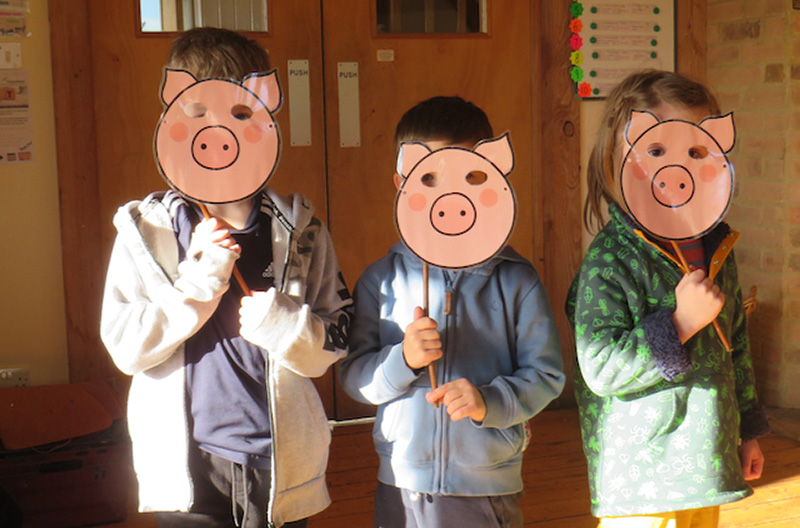
Join us for a magical, cross-curricular experience that will bring the story of the three Little Pigs alive for your class, whilst also consolidating ‘everyday materials’ learning. Team challenges, games and crafts all take place in the enchanted surroundings of our wider nature-reserve and unique buildings.
Exciting activities include:
- A lively re-cap of the story, encouraging simple actions, role-play and singing.
- Exploring different materials and their properties with some active games.
- Working in small groups to build mini houses from straw, sticks and clay.
- Visiting our replica iron age round house and discovering how it was made
- Shelter building challenge – can your team stay safe from the huffing, puffing wolf?
National Curriculum Links:
- EYFS Physical Development:Gross motor skills: negotiate space and obstacles safely and demonstrate strength and coordination (shelter-building); Fine motor skills: use a range of small tools (craft activities)
- EYFS Understanding the World:Explore the natural world around them
- EYFS Expressive Arts and Design: Safely use and explore a variety of materials (materials feely box challemge and using a range of materials to create a miniature home for the three little pigs)
- Perform songs, rhymes, poems and stories with others (recap the story and sing together as a group)
- KS1 Literacy:Apply phonic knowledge and skills as the route to decode words (reviewing words to describe material properties)
- KS1 Science: Year 1: Everyday materials: Distinguish between an object and the material from which it is made (Material feely-box challenge); Identify and name a variety of everyday materials, including wood, plastic, glass, metal, water, and rock (Material feely-box challenge); Describe the simple physical properties of a variety of everyday materials (Material feely-box challenge); Compare and group together a variety of everyday materials on the basis of their simple physical properties (Run-around opposites game).
- Year 2: Uses of everyday materials: Identify and compare the suitability of a variety of everyday materials, including wood, metal, plastic, glass, brick, rock, paper and cardboard for particular uses (Material feely-box challenge).